After years of being available internationally, the next-level messaging protocol known as RCS has landed in the U.S. and is a major leap forward for how your brand interacts with your customers through mobile messaging.
And now that the most important players are in lockstep with this game-changing channel — including the wireless carriers, Google, Apple, and Tier 1 messaging aggregators like Vibes — RCS is rapidly taking off.
What Is RCS Messaging?
RCS messaging is a protocol that enhances traditional SMS/MMS messaging by bringing richer, more interactive experiences you typically get from a messaging app like Facebook Messenger or WhatsApp, right inside your native messaging app.
RCS stands for rich communication services
Developed by the GSMA in 2007-2008, RCS adoption began accelerating in the European markets, exclusively with Android users. Fast forward to today, with Apple’s adoption of the protocol, it’s now reaching critical mass in the U.S., not only among consumers, but also with brand-to-consumer communication.
When it comes to RCS for brand marketers, it is the application-to-person (A2P) protocol that enables you to communicate with your customers.
With superior features like rich carousels of visuals, one-tap replies, and verified brand identity, RCS offers the richness that mobile apps do today, plus an extended reach — because there’s no app download required by your customers to begin using RCS. It’s the boost in market penetration brands have been craving.
What RCS means for everyday users
RCS messaging - also referred to as RCS chat or RCS texting - brings enriched, interactive experiences to everyday users that you typically find in a separate messaging app like Facebook Messenger, directly into your native messaging app. It does everything SMS and MMS can do, but makes it even more interactive and visual.
If sending and receiving video content and getting conversational cues like typing indicators and read receipts via SMS was considered messaging 2.0, then RCS is messaging 3.0.
How RCS Messaging Works
Let’s break down how RCS messaging functions, and how it works both similarly and differently than SMS messaging.
How RCS messages are sent (vs. SMS)
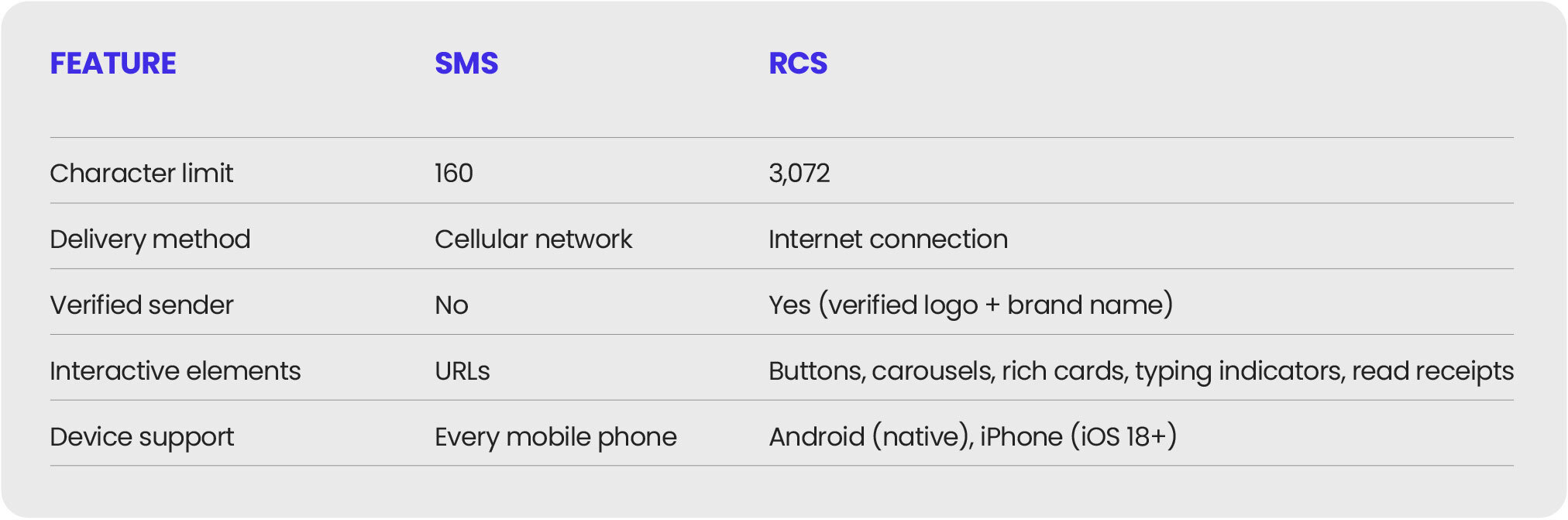
SMS messages are sent over cellular networks through your wireless carrier, which doesn’t require an internet connection. Conversely, RCS messages are sent via the internet, so they require a WiFi connection or use of cellular data.
In the event an RCS message is attempted on a device that is not RCS-enabled, an SMS fallback message can be set up to send instead (so long as the messaging provider you’re working with can enable logic between RCS-enabled and non-RCS-enabled devices).
The role of Google, Apple, and the wireless carriers
Google is the primary technology provider that offers the platform for routing RCS messages.
Unlike RCS in international regions, Google has partnered closely with the major wireless carriers — T-Mobile, AT&T, and Verizon — who are enabling access to their customer base, along with providing the rules and regulations alongside another organization called the CTIA, who is the consortium in which the carriers work through to ensure RCS messaging is compliant and trustworthy.
Then you have the aggregators like Vibes, who are providing connectivity to the Google RCS infrastructure.
Consumer RCS vs. RCS for Business
Consumer RCS vs. RCS for Business both use the RCS protocol, but it’s used in a different way.
Let’s start with consumer — also referred to as peer-to-peer (P2P) — RCS: think of it as the text message you send your friend, and you’re the iPhone user and they’re the Android user. With RCS, you get to take advantage of communication features like typing indicators, read receipts, and sharing high-resolution images that stay high resolution.
RCS for Business — formerly known as RCS Business Messaging (RBM) — is your application-to-person (or A2P) messaging, which is brands and businesses communicating with consumers. Like consumer RCS, you get very similar things, but you also get key features that don’t exist in the P2P version of RCS, such as:
- Verified identity, which is the process of your brand being vetted by Aegis, a third-party agency that validates that you are the brand you say you are.
- One-tap suggested actions and replies for the user to take.
RCS Features for Consumers and Businesses
RCS offers a variety of features for both consumers and businesses.
Consumer features
- Ability to share beautifully rich images and video visuals, plus improved messaging overall between Android and iPhone users.
- Ability to send large files directly in the RCS conversation.
- Typing indicators (like animated ellipses) and read receipts that elevate the conversational nature with two-way messaging.
- Group messaging enhancements, e.g., making it easier to add/remove individuals from the group RCS chat.
Business messaging features
- Verified sender branding: Inclusive of a checkmark, this identity verification feature gives users the confidence they know they’re talking to the brand they expect.
- Rich cards and carousels: Beautifully rich image and video visuals — with carousels of up to 10 cards, users can easily scroll/swipe through.
- One-tap suggested actions and replies: Suggested action buttons are natively built into RCS that integrate with other native OS tools, making it simpler than ever to do things like Open a URL, Dial a Number, View a Location, Share a Location, or Create a Calendar Event. Suggested reply buttons are customizable to fit within the flow your brand is setting up, essentially replacing a user needing to type out their responses in the RCS conversation, which keeps them highly engaged.
- Enhanced analytics: RCS gives more visibility into message engagement, like read receipts, interaction timing, reactions, and conversions.
RCS vs. SMS: The Differences
Here are a few key differences between RCS and SMS features.
Feature-by-feature comparison
When to use SMS vs. RCS
- Brief, straightforward messages. Alerts like two-factor authentication (2FA) are only single-use codes that are requested by users to easily verify their identity, which can easily be achieved via SMS.
- For the widest reach. Currently, every mobile device is SMS compatible, while 100% RCS market penetration has not yet been reached. Especially if your audience may skew towards having older devices or are slower to adopt new technology, SMS may be your better option.
- As an RCS fallback strategy. It’s always a good idea to lean on SMS for fallback messages that non-RCS-enabled devices can accept.
RCS vs. SMS cost considerations
Each carrier has a different fee associated with RCS vs. SMS messages, and these fees are subject to change by the carriers as they see fit. As defined by the carriers, RCS currently breaks down into these two categories that are priced differently:
- RCS Rich Messages: similar to SMS, Rich Messages only contain plain text that’s no more than 160 characters. They can also only include certain built-in suggested action buttons — ‘Dial a Number’ and ‘Open URL’ (where the URL redirects to the user’s browser outside of their messaging app). They do not contain any media, e.g., images or videos.
- RCS Rich Media Messages: this category can support text that’s more than 160 characters and can contain media files. They can also include any/all suggested action and reply buttons.
Since this always has a chance of changing, Vibes advises our customers to refer to our Carrier Fee Calculator for the latest and greatest rates.
Since RCS is conversational in nature, the carriers and Google are working to finalize a conversational pricing framework, which is expected to come once they’ve determined what makes up the scope of a standard RCS conversation.
RCS on iPhone vs. Android: The Differences
Like most user experiences, RCS takes on a different look and feel, whether you’re an iOS user or an Android user. Here’s a breakdown of how it comes to life in both instances.
Suggested action & reply buttons
iOS and Android take slightly different approaches in terms of how these one-tap buttons appear as part of an RCS message.
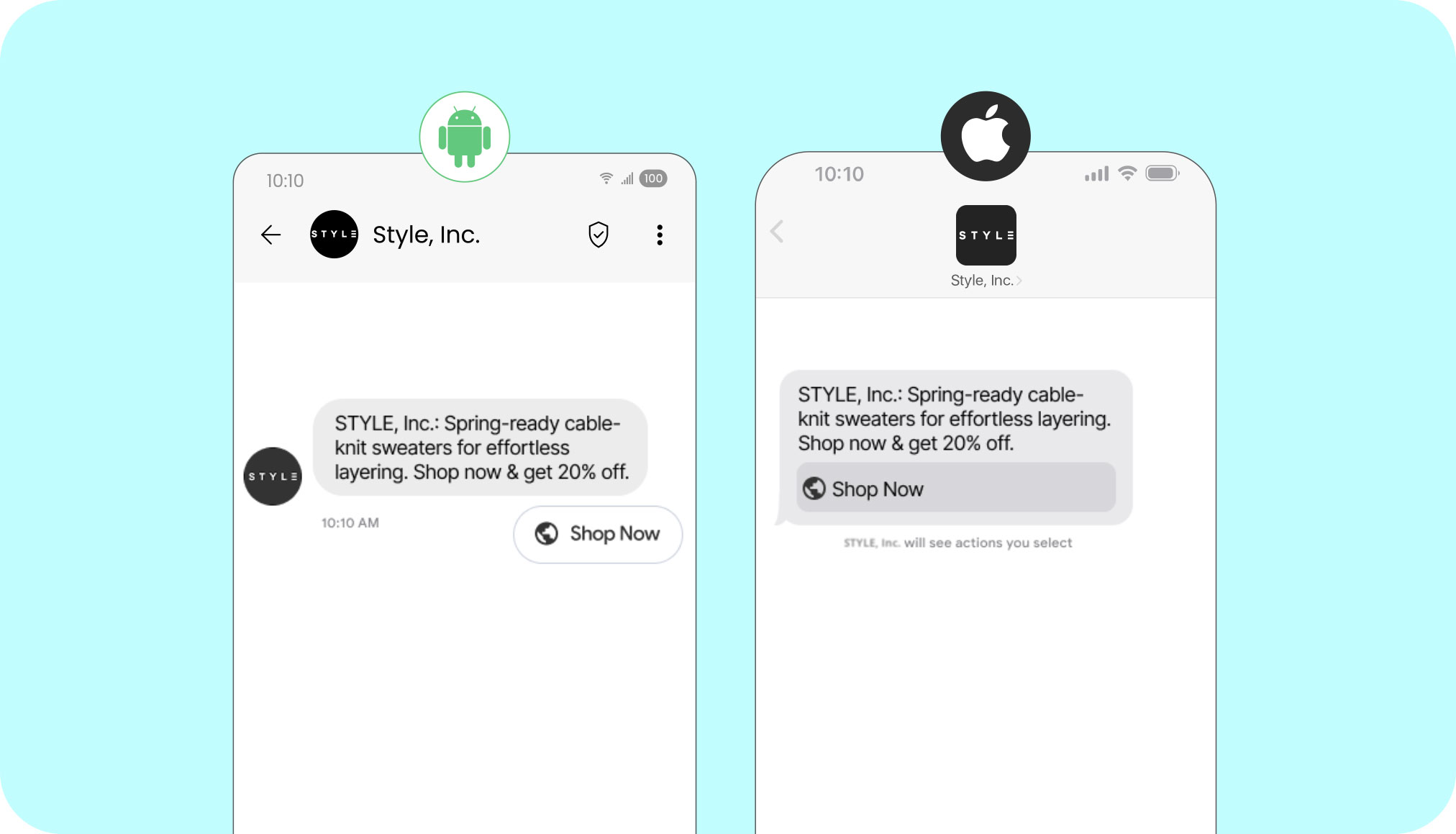
Since suggested actions appear in a dropdown menu within the iOS rich card itself, if you include more than one Suggested Action in your rich card, the dropdown box with read "Options", requiring the user to click on it to see the suggested call-to-action buttons. This is why Vibes recommends including only one suggested action per rich card for iOS users, eliminating that extra click in order for your customers to see what action to take next.
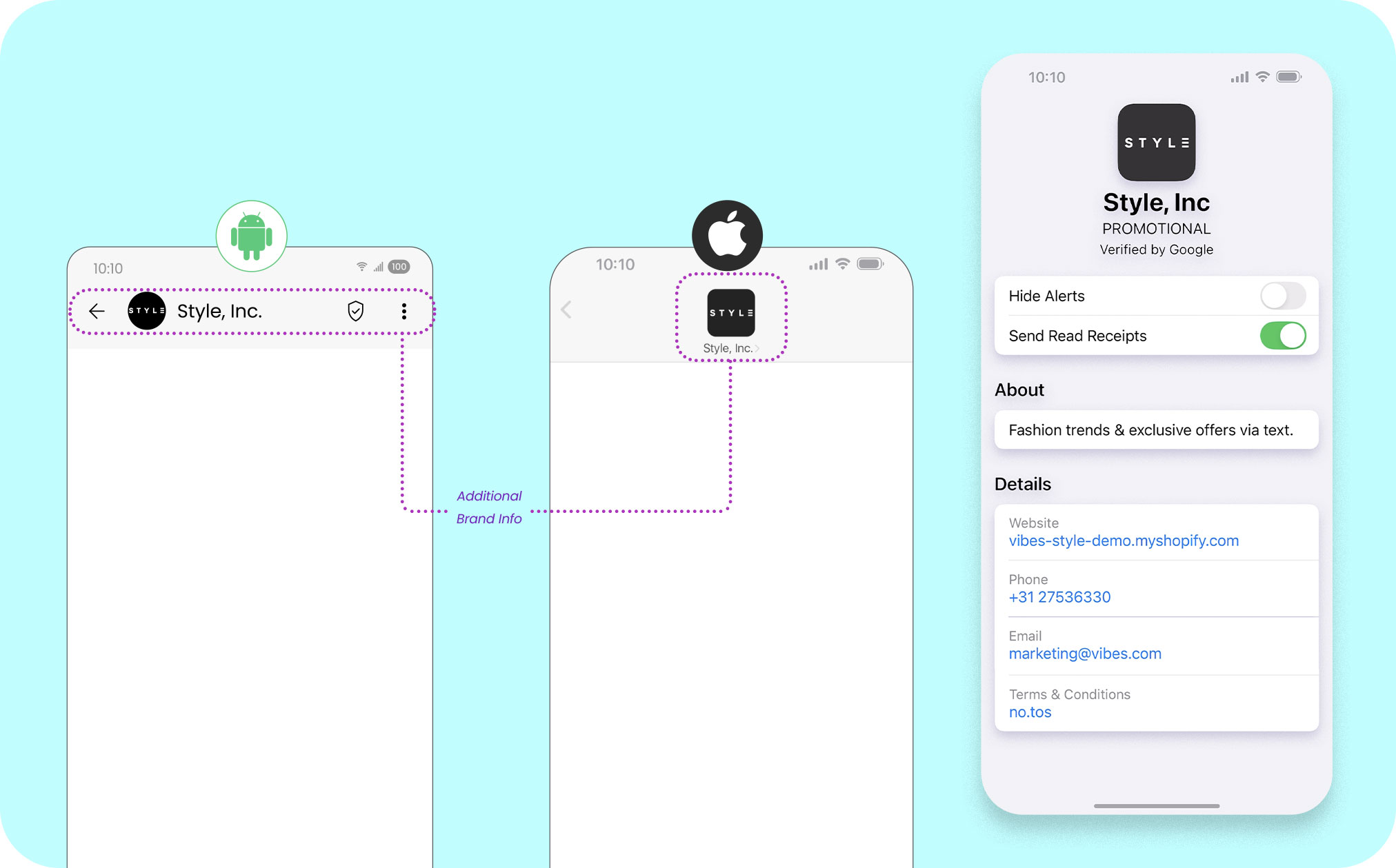
Verified RCS agent
With a slightly different look, Android and Apple put your branding front and center with RCS messages to help reassure your customers they’re talking to the brand they expect to be interacting with.
Rich cards and carousels
Android and Apple also took slightly different approaches in how they present images, videos, descriptions and suggested next steps within a single rich card within the message.
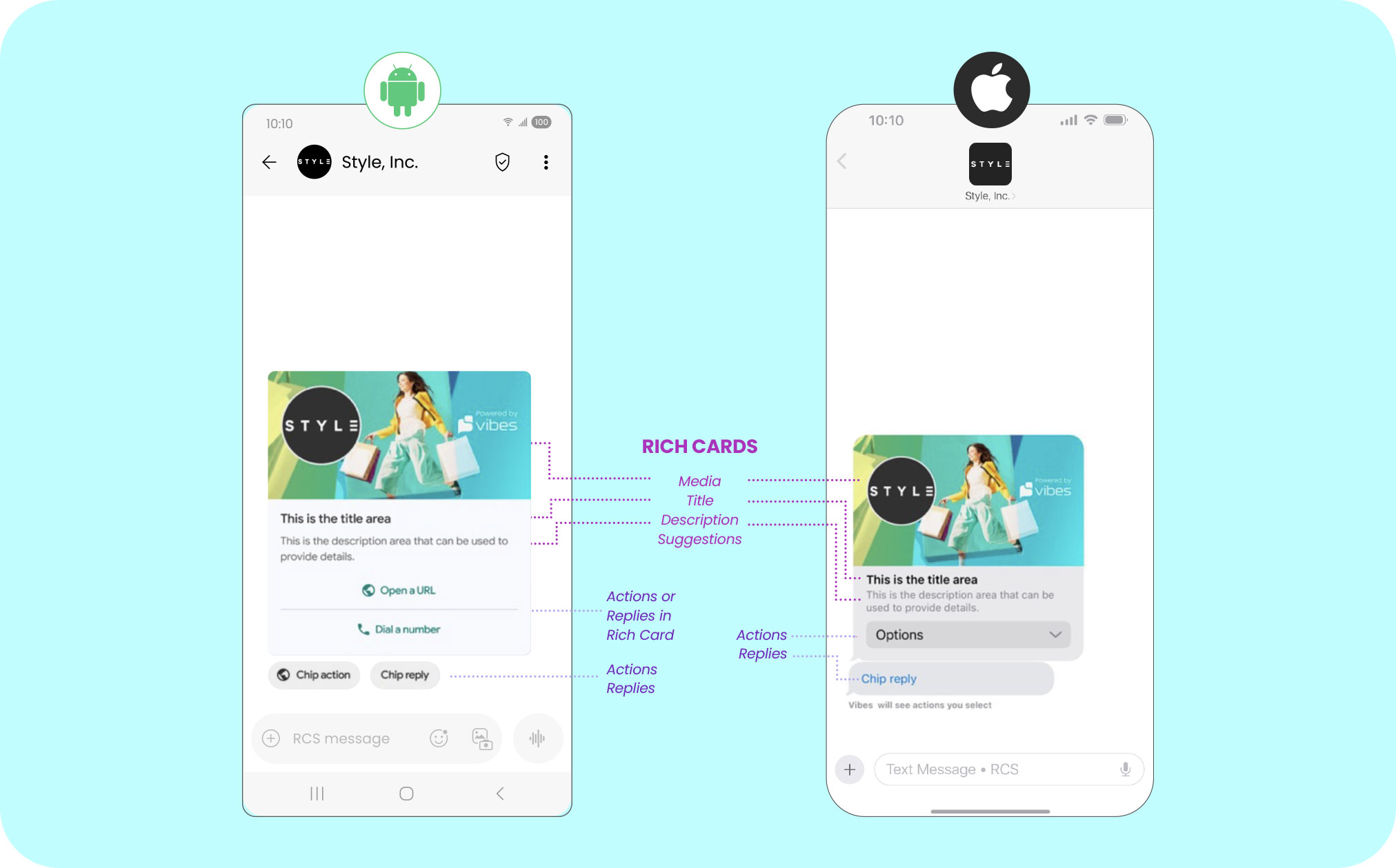
Regardless of OS, while a great feature of rich cards is the ability to include descriptive text along with your visuals, this doesn't mean it's time to write a mini novella. RCS rich cards allow for descriptions that fit within 3 lines of text, and to avoid the dreaded ellipses that signals the rest of your message has been cut off, Vibes recommends sticking to ~115 characters max.
Be sure to download Vibes’ comprehensive RCS guide for other key UX considerations between the different operating systems and other actionable intel.
How RCS Is Transforming Business Messaging
Here are a few ways RCS is being used to take brand-to-consumer messaging to the next level.
Marketing and promotions
RCS is a more engaging, effective way to market to your customers. Just imagine the ability to send your customers a carousel of images promoting deals personalized for them that they can scroll through. Plus, pairing each carousel with single-tap “Shop Now” buttons makes it easier for customers to find what they need.
These visual elements and smoother interactions will lead to higher conversion rates and drive overall customer satisfaction.
Customer service and support
Question about an existing order? Need help with managing an existing reservation? RCS makes all of this not only possible for your customers, but also helps to solve issues faster within the RCS chat — especially because there’s less toggling between a messaging app, a web browser, and a mobile app.
The interactive features, like read receipts and typing indicators, also aid in providing a superior customer service experience because your customers are seeing when you are writing a message back to them, recognizing that you are actively working to solve their issue.
Transactional and post-purchase communication
RCS has several key features it offers that are built right into the solution (i.e., no custom tech integration work required) and elevate the transactional and post-purchase experience.
“View location”, which is integrated with the phone’s maps application, makes it easy for your customers to get directions to a location they need to get to for picking up an order, for instance.
There’s also “Dial a number”, which is helpful if a customer has a question about an existing order or a reservation they made.
“Add to Calendar” is another option, which makes it easy for customers to add an upcoming reservation to their calendar. It’s also a good action to consider if you’re having a grand opening of a new location or an on-site event.
Loyalty and retention
RCS makes messaging feel like an authentic conversation between your brand and customers, especially when the messages can be tailored to each individual.
Take preference gathering, for example: the chat-like, conversational functionality RCS offers can make the data collection experience much easier for your customers, who just have to click on the button that resonates most with them instead of having to fill out a web form or fields in a preference center.
When you use this collected data to curate eye-catching images coupled with easy, one-tap suggested replies, RCS offers a more streamlined communication experience that sparks conversation and keeps your customers highly engaged, which builds lasting customer loyalty.
How to Get Started With RCS — A Brand's Roadmap
So how do you get started? The good news: launching RCS doesn’t require building a new app or hiring a dev team. With the right partner, here’s how you can launch your first RCS campaign in a matter of weeks.
1. Understand the RCS ecosystem
RCS marketing requires working with a messaging aggregator, and like any industry, not all aggregators are created equal.
Tier 1 aggregators like Vibes have direct carrier connections that give brands unmediated access to faster RCS agent registration and quicker, compliant campaign approvals, which is how we launched more RCS agents in Q4 2025 than any other direct connect aggregator.
2. Submit your RCS agent request
RCS is run through a separate agent that uses the RCS protocol to send and receive messages on your behalf and becomes the face of your brand’s verified messaging profile. You’ll submit your request by providing some key brand and program details via an RCS agent registration form.
Vibes helps to accelerate this process by handling everything from this step forward on a brand’s behalf.
3. Get your agent created with Google
Once submitted, your agent gets created in the Google Business Messaging ecosystem.
4. Get your brand verified
This step is handled with a third-party verification platform, Aegis, to validate that the brand you submitted belongs to the proper owner and that you’re entitled to use the brand name, logo, and other submitted assets.
5. Submit to wireless carriers for approval
Once verified, your agent is submitted to carriers for launch approval.
6. Launch in market
Once approved, your RCS agent is considered “live”, and you can start sending beautifully branded, interactive messages directly to your RCS-enabled customers.
Compliance considerations
While official guidelines for RCS are still being finalized by the entities that establish mobile marketing regulations — like the FCC — it’s expected that the compliance policies will mirror SMS/MMS to honor the consumer’s right to control how they receive communication from brands through mobile messaging.
Currently, Google refers to the CTIA guidelines as a reputable source for how to manage consumer consent to start and stop receiving RCS messages from brands.
Why a Tier 1 Aggregator Matters for RCS
Tier 1 aggregation provides a direct, unmediated connection between wireless carriers and any business or application trying to send a large volume of messages. As opposed to messaging middlemen, Tier 1 aggregators ensure messages take the absolute fastest path from companies to their customers.
The Vibes advantage for RCS
Vibes and our 25+ years of mobile messaging leadership, plus our direct carrier connections, have us now lighting the RCS path for brands across the US.
We launched more RCS agents in Q4 2025 than any other direct connect aggregator, and top brands are already seeing a 93% increase in revenue vs. their SMS campaigns.
Businesses using Vibes’ RCS platform gain the advantage of our having partnered with the carriers, Google, and Apple from the start, including our early-access partnership with Google at the initial launch of RCS. These years-long relationships are how we can get you up and testing RCS within 24 hours.
Vibes is more than a platform — we’re your partner. Each one of our customers is paired with a dedicated mobile messaging expert who’s seen it all. From campaign strategy to RCS best practices, our team is here to guide you, optimize your messaging, and help you make the most of this powerful new channel.
And when it comes to RCS scale, Vibes now offers RCS Studio: the only end-to-end platform that handles RCS agent creation, provisioning, compliance, and carrier delivery, all in one place. RCS Studio manages the entire RCS lifecycle, so your team doesn’t have to. From creation to delivery, everything happens in one simple, secure interface.
Get in touch to get started with RCS today.
The Future of RCS — What's Ahead in 2026 and Beyond
If you aren’t excited about RCS yet, here are a few developments in the works.
Growing North American coverage and adoption
Since Apple began supporting RCS upon the release of iOS 18 in late 2024, usage and adoption of the channel in the US and Canada continue to exponentially grow. Between almost 100% wireless carrier coverage — including support from the top wireless carriers AT&T, T-Mobile, Verizon, and Bell — and coverage across most Android and iOS devices, RCS as the new standard of mobile messaging is within reach.
Enhanced conversational commerce
There are elements of conversational commerce within RCS today, like the ability to call a payment API to ask for certain information to confirm a payment.
However, RCS is paving the way for built-in commerce solutions (i.e., native payment integrations through Apple Pay/Google Pay) that allow your customers to actually complete a payment without being redirected out of their messaging app to a separate browser or a mobile app, reducing the friction that can keep consumers from purchasing.
Deeper AI integrations
RCS and AI together unlock exciting new possibilities — including the potential for smarter RCS agents that can handle more complex customer interactions.
Take message send times, for instance: AI analyzes user characteristics, engagement patterns, and other data to determine an optimal send date and time. Then RCS's granular data — including read receipts, interactions with rich media elements, and detailed engagement signals — enables AI to refine its predictions and dynamically adjust schedules based on real-time data.
Another example is A/B testing, which RCS will expand by allowing experimentation with multimedia elements and delivering specific engagement data for each component: Do users interact more with carousels? Do video messages with discount promotions generate more revenue than those using images? AI uses these metrics to identify which combinations of features and visuals will drive the steadiest engagement and highest conversions.
Coupled with AI’s ability to generate content, testing could evolve to AI autonomously creating new element variations for continuous optimization.
The Bottom Line for Businesses
RCS is bigger than messaging — it combines the reach and immediacy of SMS with the interactivity of mobile apps. Early adopters of this innovative channel gain a significant market advantage when it comes to customer retention and revenue.
Because launching a new channel can feel overwhelming, working with a partner like Vibes will make it easy for you to launch RCS and take your relationship with your customers to a whole new level.
Don't get left behind. See how Vibes can have you up and testing within 24 hours!
RCS Messaging FAQ
What does RCS mean in text messaging?
RCS is a protocol that enhances the messaging experience by offering richer interactions you’d typically find in a separate messaging app (such as WhatsApp) directly within the native messaging app on your smartphone.
What is the difference between RCS and SMS?
SMS is plain text and clickable URLs only. RCS offers richer, more interactive features to make it a more elevated messaging experience.
Is RCS available on iPhone?
Yes, Apple made RCS available on all iPhone devices when they rolled out iOS 18.
Does RCS cost money?
For consumers, RCS uses a data plan like SMS and any other mobile app. For businesses, pricing varies by carrier and the messaging aggregator you choose to work with.
Is RCS more secure than SMS?
Yes, for P2P, RCS as a protocol can achieve end-to-end encryption if both devices are Google devices. However, while RCS for Business does have appropriate levels of security when it comes to moving the data around on various networks, it currently does not have end-to-end encryption, so it is not currently considered more secure than SMS.
Can businesses use RCS for marketing?
Yes. RCS for Business is the business-to-consumer version (or “A2P” in telecoms terminology) of RCS for Consumers that enables brands and businesses to communicate directly with their customers.
How long does it take for a brand to launch an RCS agent?
It can vary depending on the messaging aggregator a brand is working with. With our years-long relationships with all US carriers as a Tier 1 aggregator, brands working with Vibes’ RCS platform are able to get agents launched in the market much faster than those working with non-Tier 1 aggregators — in fact, Vibes can have you up and testing your RCS agent within 24 hours.
How is an RCS chat or conversation initiated?
A brand can initiate an RCS conversation with consumers through their messaging aggregator. Consumers can also initiate the RCS interaction with an RCS agent, such as clicking a “let’s chat” button on a brand’s website to trigger a conversation.
What happens if the recipient doesn't have RCS?
If the recipient doesn’t have RCS, the messaging provider a brand is working with should have the ability to set up an SMS fallback experience for their subscribers.
What if I am a developer who wants to build and launch my own RCS agent(s)?
Vibes has you covered with RCS Studio, the turnkey provisioning, compliance, and management platform that allows developers to join the RCS revolution right now. Developers can create their first RCS messages and launch them to devices in less than 5 minutes!